Saturday, January 21, 2012

Asheville Move to Amend


Move to Amend Action in Asheville

Saturday, October 15, 2011

Friday, September 30, 2011
From A Georgia Jail to a Tennessee Courtroom: One Truthteller's Story
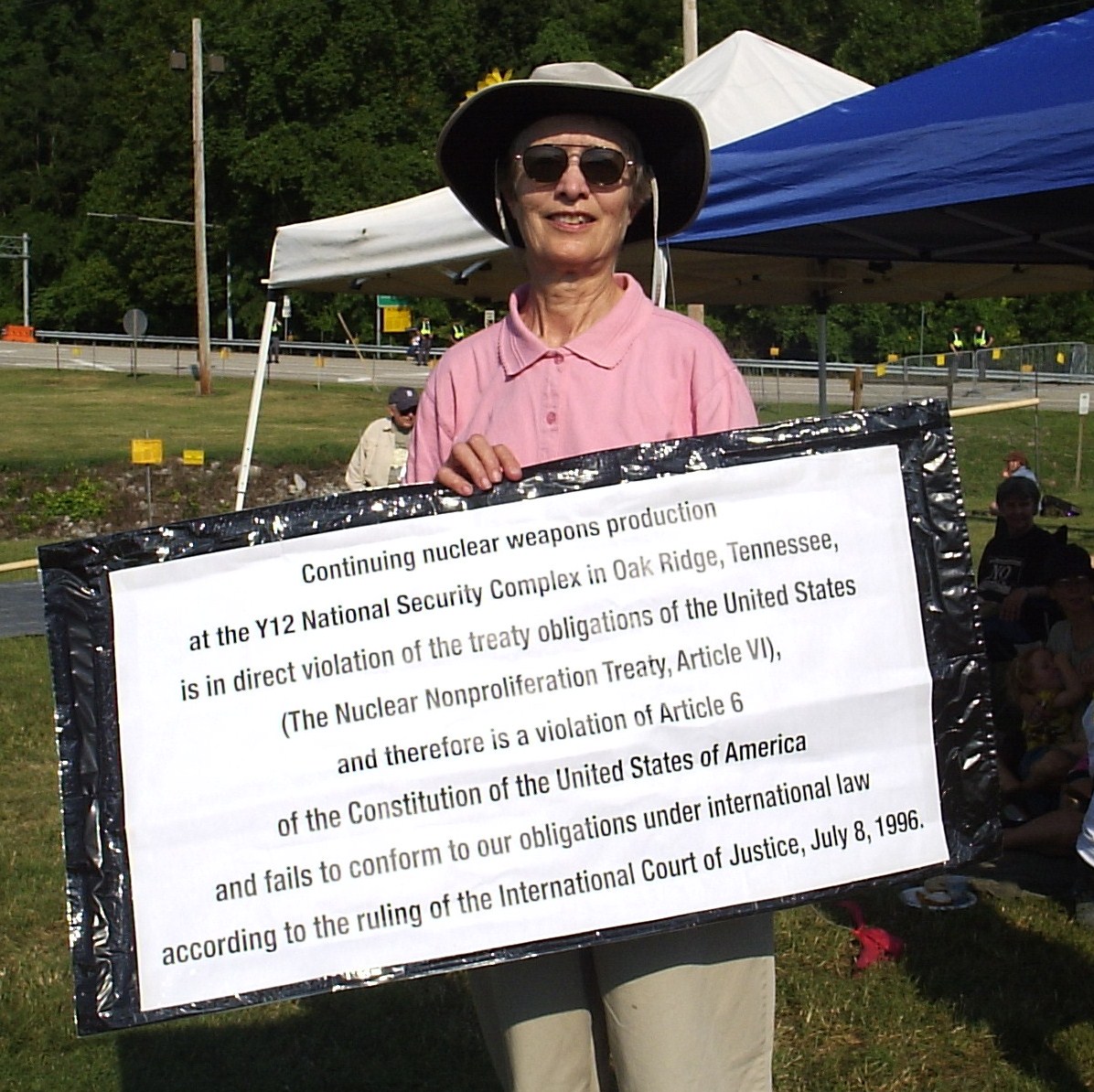 Catholic sister Mary Dennis Lentsch is persistent and unrepentant in her resistance to the crime of nuclear weapons production at the Y-12 Nuclear Weapons Complex in Oak Ridge, Tenn.
 She stood before judge Bruce Guyton in Federal court . on September 21 to be sentenced for her nonviolent civil resistance at the Y12 bomb plant in July of 2010. According to Ralph Hutchinson of the Oak Ridge Environmental Peace Alliance, the courtroom was full of supporters as Mary Dennis was brought in in shackles; she had been in custody since mid-June in a private jail in Ocilla, Georgia. She was surprised to hear the Judge's sentence of "Time Served," after enduring nearly four months in jail for peacefully stepping through a three-strand barbed wire fence and joining a circle of 12 others in a prayer for an end to nuclear weapons.
At her sentencing, over one year later, she stood in shackles as she addressed the courtroom:
“...I bow to the sacred in everyone. I bow to the sacred in the plants and animals. I bow to the sacred in all creation....In order to protect all the sacred gifts of creation, I feel called to do whatever is necessary to abolish nuclear weapons."
From a letter to friends, September 28, 2011:
My travel from the Ocilla jail [in Georgia] to Knoxville for the sentencing was quite an experience. On September 20, at 12:30 am I was told to pack up for transport. It took me about 20 minutes to pack and then I waited until 2:30 until they came to get me from my cell and take me down for the exit processing. During the processing we were given a bag lunch breakfast and finally at 4:30 we were loaded into the van. Doris and I were the only women and there were 7 men. I had heard stories that there were no bathroom stops during the 7 hour drive so I had curtailed my liquid intake. It was true there were no bathroom stops. I had also heard that it was freezing and wore two long sleeve thermal shirts—this was also true. I was skeptical when I heard they drove 80-90 miles per hour. Well, I sat right behind the driver and kept looking over his shoulder and sure enough this was true. I could not believe when we maintained this speed in a construction zone that said 55-60. I’m hoping this is a “once in a lifetime” trip for me.
Of course, we were completely shackled for this trip.
When we arrived in Knoxville Doris and I were placed in a federal holding cell in the Federal Court House. The Ocilla chains were removed and we put on the court house chains and sat in freezing temperature from 11:00 am-3:00 pm. Then they came and transported us to the Knox County Jail where they removed the court house chains and put on the KCJ chains. Then we were transported in a paddy wagon to the Knox County Penal Farm where we would be booked.
We arrived at the Penal Farm at 4:15 pm and sat, chained, in a variety of holding pens until our processing was completed at 3:30 am. I was in my cell and slept from 3:30 am to 6:30 am when
I was awaked to eat my sack lunch breakfast. Eventually a guard came to me and said, “The U.S. Marshals couldn’t find you. It is late now so a special car will rush you to court.” Again,
chains needed to be put on. I was relieved to arrive at the court room about 5 minutes before the 9:30 court session...
Mary Dennis Lentsch
1936 Liberty Hill Road Washburn TN 37888
We Must Abolish Nuclear Weapons!!
To learn about the other 12 who served and are still serving jail time, click here.
Tuesday, September 27, 2011
#10 of 198 Methods of Nonviolent Direct Action
Communications with a Wider Audience
#10. Newspapers and journals
Two early examples of the power of the press to bring social change include The Masses (1911-1917) and The Liberator (1918-1924)
(Two contemporary local newspapers are The Global Report (formerly The Asheville Global Report) and The War Crimes Times.
 The Masses"...A revolutionary and not a reform magazine: a magazine with a sense of humour and no respect for the respectable: frank, arrogant, impertinent, searching for true causes: a magazine directed against rigidity and dogma wherever it is found: printing what is too naked or true for a money-making press: a magazine whose final policy is to do as it pleases and conciliate nobody, not even its readers." - Max Eastman
The August 1915 cover of The Masses is particularly relevant today with the execution of Troy Davis by the state of Georgia, despite more than reasonable doubt as to his guilt.
In July 1913, The Masses published Art Young's cartoon 'Poisoned at the Source,' which depicted the Associated Press' president, Frank B. Noyes, poisoning a well labeled 'The News' with lies, suppressed facts, slander, and prejudice. The cartoon was a response to the lack of national news coverage on the Paint Creek-Cabin Creek strike of 1912 in Kanawha County, West Virginia. The strike had lasted more than a year, and was characterized by deadly clashes between miners and militia hired by the coal companies.The coal wars continue today with mountaintop removal coal mining and the
The Masses was followed by The Liberator that published from 1918 - 1924.
Here is excerpt from Helen Keller's article in the first issue:
The Liberator, New York, NY, 1918, March, Issue (Whole) No. 1, page 13.,
" Down through the long, weary years the will of the ruling class has been to suppress either the man or his message when they antagonized its interests. From the execution of the propagandist and the burning of books, down through the various degrees of censorship and expurgation to the highly civilized legal indictment and winking at mob crime by constituted authorities, the cry has ever been “crucify him!” The ideas and activities of minorities are misunderstood and misrepresented. It is easier to condemn than to investigate. It takes courage to steer one’s course through a storm of abuse and ignominy. But I believe that discussion of even the most bitterly controverted matters is demanded by our love of justice, by our sense of fairness and an honest desire to understand the problems that are rending society." read more
#10. Newspapers and journals
Two early examples of the power of the press to bring social change include The Masses (1911-1917) and The Liberator (1918-1924)
(Two contemporary local newspapers are The Global Report (formerly The Asheville Global Report) and The War Crimes Times.
 The Masses"...A revolutionary and not a reform magazine: a magazine with a sense of humour and no respect for the respectable: frank, arrogant, impertinent, searching for true causes: a magazine directed against rigidity and dogma wherever it is found: printing what is too naked or true for a money-making press: a magazine whose final policy is to do as it pleases and conciliate nobody, not even its readers." - Max Eastman
The August 1915 cover of The Masses is particularly relevant today with the execution of Troy Davis by the state of Georgia, despite more than reasonable doubt as to his guilt.
In July 1913, The Masses published Art Young's cartoon 'Poisoned at the Source,' which depicted the Associated Press' president, Frank B. Noyes, poisoning a well labeled 'The News' with lies, suppressed facts, slander, and prejudice. The cartoon was a response to the lack of national news coverage on the Paint Creek-Cabin Creek strike of 1912 in Kanawha County, West Virginia. The strike had lasted more than a year, and was characterized by deadly clashes between miners and militia hired by the coal companies.The coal wars continue today with mountaintop removal coal mining and the
The Masses was followed by The Liberator that published from 1918 - 1924.
Here is excerpt from Helen Keller's article in the first issue:
The Liberator, New York, NY, 1918, March, Issue (Whole) No. 1, page 13.,
" Down through the long, weary years the will of the ruling class has been to suppress either the man or his message when they antagonized its interests. From the execution of the propagandist and the burning of books, down through the various degrees of censorship and expurgation to the highly civilized legal indictment and winking at mob crime by constituted authorities, the cry has ever been “crucify him!” The ideas and activities of minorities are misunderstood and misrepresented. It is easier to condemn than to investigate. It takes courage to steer one’s course through a storm of abuse and ignominy. But I believe that discussion of even the most bitterly controverted matters is demanded by our love of justice, by our sense of fairness and an honest desire to understand the problems that are rending society." read more
Subscribe to:
Posts (Atom)